
CodeAtlas
Finds the tests that reach a code change, runs both revisions and signs the evidence.
- Role
- Sole developer: product design, analysis pipeline, CLI, evidence model and workspace
- Dates
- Jul 2026 – present
- Status
- Local CLI · merged 6 Oct
- Stack
- TypeScript, Node.js, Vitest
In short
Observed behaviour
It runs the tests on both revisions, three times each, and confirms a regression only when the repeated runs agree.
Tamper-checked replay
Replay checks the SHA-256 artifact digests and the Ed25519 manifest signature before it starts a test.
Stated limits
It runs trusted local code only, and unsupported or incomplete evidence stays marked unverified.
Engineering challenges
-
A generated test cannot certify itself
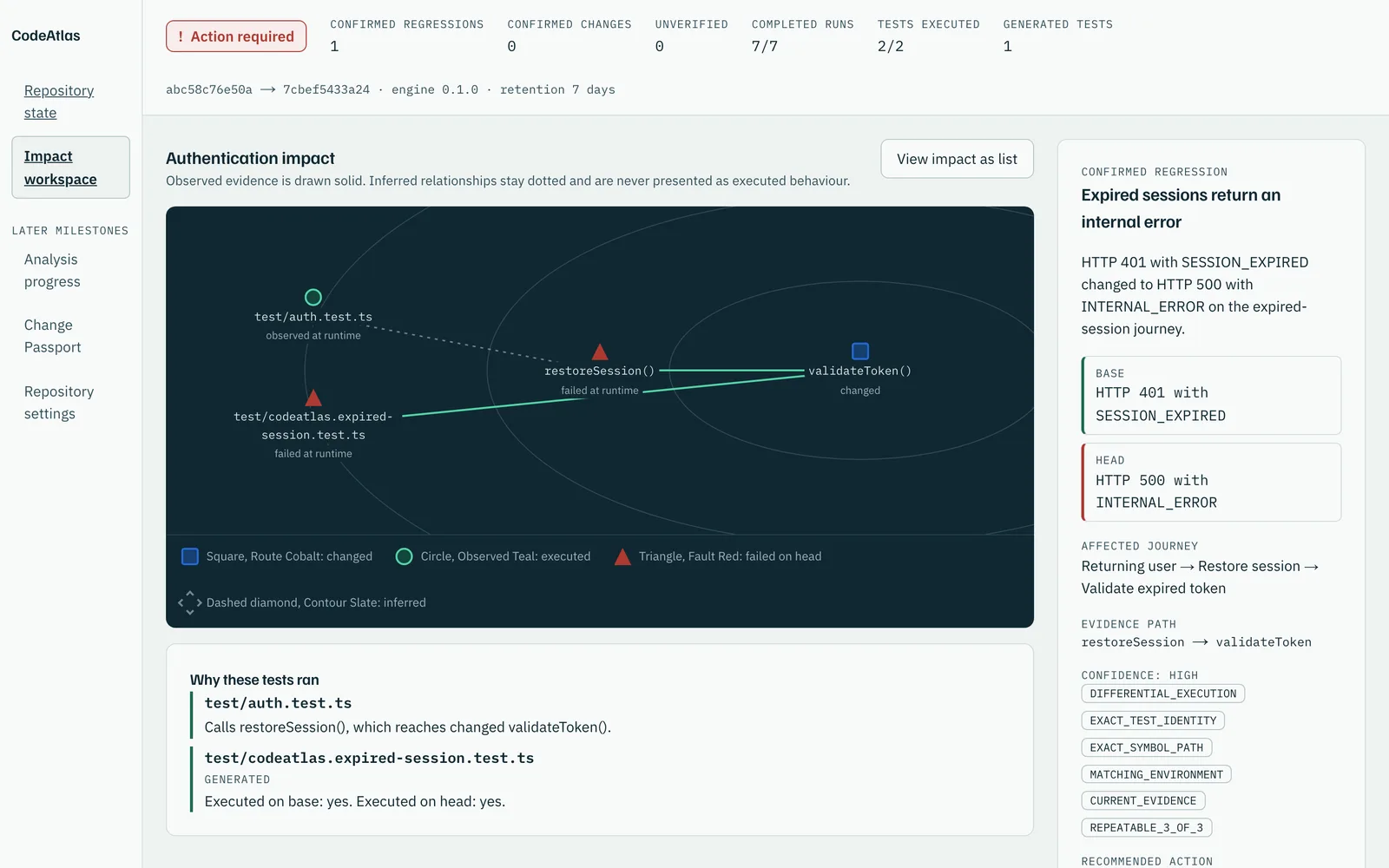
The authentication fixture shows an observed HTTP 401 on the base revision and HTTP 500 on the head, with a command to replay it.
The confirmed regression -
Bind replay to the recorded evidence
Replay reports REPRODUCED, NOT_REPRODUCED or ENVIRONMENT_MISMATCH and states which evidence it checked.
Technical decisions
| Decision | What I chose | Instead of |
|---|---|---|
| Local execution has an explicit trust boundary | Run trusted local snapshots with bounded subprocesses | Calling temporary copies and process limits a sandbox for hostile code |
242 tests passed in CI
- tests in the 6 October CI run
- 242
- runs of each test per revision
- 3
- regression reproduced on the fixture
- 401 → 500
That CI run also found a temporary-file cleanup defect, since fixed and covered by a regression test.
Working with AI tools
Define: Test-impact evidence must remain independently verifiable and tamper-proof. Decide: Run separate execution passes for both Git revisions and cryptographically sign the resulting evidence. Investigate: Agents suggested letting generated test-selection outputs certify their own coverage without independent verification. Verify: Enforced dual-revision execution where evidence artifacts cannot attest to themselves.
Full engineering notes
Summary
A code review shows what changed in the text, but a passing test suite can still miss a changed branch. CodeAtlas maps TypeScript and JavaScript snapshots, selects the tests that reach changed symbols, and runs both revisions to compare their behaviour. For its supported authentication fixture, it generates a narrow test for an uncovered expired-session condition and records the observed 401-to-500 regression. I built the local analysis, execution, evidence and replay workflow, plus a web workspace for reading the result. It is a working local tool for trusted repositories; there is no hosted service, sign-in, GitHub App or hostile-code sandbox.
The problem
A diff shows which lines changed. Showing which behaviour changed takes running both revisions.
- Existing tests can pass on both revisions while an uncovered condition regresses.
- A finding needs a traceable connection between the changed source, the test, the observed result and the environment.
- A replay command must reject missing signatures or altered evidence before it executes code.
My role
What I owned
- The snapshot analysis, explainable test selection and differential comparison pipeline.
- The evidence schemas, canonical artifact digests, signed manifest and Change Passport.
- The local CLI, replay validation and bounded process execution for trusted repositories.
- The workspace that presents evidence, uncertainty and replay commands.
What I did not own
- TypeScript parsing and compiler infrastructure, Node.js, Vitest and Playwright.
- Next.js and React for the workspace.
- No hosted authentication or repository sandbox is claimed as implemented.
Product flow
Parse base and head snapshots without executing repository code; identify changed symbols and branches.
Select tests through the call graph and record why each test was chosen.
Derive a supported test objective from uncovered changed behaviour and generate a narrow test.
Run existing and generated tests on both revisions, three times, with time and output limits.
Confirm a regression only when compilation, execution, environment and repeated observations agree; otherwise retain the uncertainty.
Canonicalise and sign the evidence, then verify the bundle before replay launches a test process.
How each challenge was solved
A generated test cannot certify itself
- Why it was hard
A generator can produce plausible code or forged-looking output. Neither proves a behavioural difference.
- What I built
Keep objective derivation, test generation, execution observations and differential classification separate. Generated tests must compile and execute on both snapshots; missing or contradictory evidence remains UNVERIFIED.
- Trade-off
The supported generated objective is deliberately narrow. Unsupported objectives fail closed instead of promising broad automatic coverage.
- Validation
Runner and pipeline tests reject substituted suites, forged assertion data, incomplete execution and changed generated artifacts.
Bind replay to the recorded evidence
- Why it was hard
A replay that accepts a stale or modified bundle may run a different claim from the one displayed on the Proof Card.
- What I built
Use canonical SHA-256 artifact digests and an Ed25519 manifest signature. Verify artifacts, manifest and signature before resolving snapshots or starting tests; publish the current bundle alongside retained immutable artifacts.
- Trade-off
The local signing key establishes integrity within this workflow, not independent third-party attestation.
- Validation
CLI tests reject missing public keys, signatures and tampered artifact digests; repeated analyses use the matching current reproduction bundle.
Why I made each decision
Local execution has an explicit trust boundary
- Because
A working local evidence workflow can be checked without pretending that process cleanup isolates malicious code. Repository tests still execute as the current user.
- Trade-off
Untrusted repositories and hosted execution remain out of scope. Windows execution fails closed until process-tree containment is implemented.
Testing
Tests exercise schemas, analysis, selection, generated tests, process limits, tamper rejection, replay and the web workspace. A full CI run on 6 October passed 242 tests and exposed one temporary-file cleanup defect; the fix has its own regression test, and the Linux CI run on the merge to main passed.
- Artifact-store regressions passed after correction
- 17
Representative cases
The authentication fixture executes the generated expired-session test on base and head and reproduces the observed regression.
Malformed, missing or forged runtime evidence cannot be promoted into a confirmed finding.
Replay rejects altered artifact bytes or missing signature material before execution.
The artifact store keeps a temporary inode pinned through ownership-checked cleanup, preventing a replacement file from being mistaken for the original.
Results in detail
An executable local evidence workflow
The CLI produces a signed Change Passport and a replay command for the supported fixture. The workspace presents the same findings and distinguishes inferred relationships from runtime observations.
Hosted capabilities remain separate milestones
There is no public service or sign-in, no GitHub App and no sandbox for untrusted repositories. The current result is local analysis and replay for trusted snapshots.
Stack and release record
Platforms
Local CLI on macOS and Linux, Local web workspace
Built with
TypeScript 5.9, Node.js, pnpm workspaces, TypeScript compiler API, Vitest, Next.js · React, Playwright, SHA-256 · Ed25519
Testing and delivery
Local implementation on main: the CLI, browser acceptance tests and a production workspace build run in the verification gate, and Linux CI passed on 6 October 2026. No hosted deployment or public release is claimed.
Status in full
Local CLI and workspace implementation merged to main on 6 October 2026. Signed replay and artifact-cleanup fixes are tested; dependency audits report zero vulnerabilities. Focused checks, real base/head execution, type checking, production build and the Linux CI verification passed.
More work
- BupplesShared expenses, receipt review and settlement plans, backed by a multi-currency ledger.
- WayClubGroup management for teams, clubs and communities, from meetings to handover.
- AdelanteDaily-quote widgets for iPhone and Apple Watch, with one rotation rule in Dart, Swift and Kotlin.
- PhotoshootA photobooth with 52 live effects, reactive face masks and prints you can design.
- PlanketA shared calendar that shows when everyone is free and sends a plan in three taps.
- CareerOSNotices when you ship, and drafts résumé and LinkedIn lines from evidence it can cite.
- HACKFAMTeammate matching for hackathons, CTFs and game jams, event by event.


